
An Op-Ed Written By: Riker Farmer
For many Edmontonians, a trip to the grocery store is a weekly hassle. Planning large lists, organizing the pantry and hauling several bags into and out of the car, all to avoid returning to the store for an extra few items unforeseen a few days later. If for any reason you do need to return for a few forgotten or unplanned items, the detour is highly inconvenient and inefficient.
Some Edmontonians have access to a convenience store to grab these items, but these stores rarely have the infrastructure required to stock up on perishables like meat and produce. It is impossible to rely on a convenience store to carry what you need to sustain yourself and your family.
A large supermarket (>30,000 sqft) and a small convenience store (<3000 sqft) sit at distant ends of the spectrum. There are no options existing in the middle that have the “one-stop-shop” selection of the supermarket, but fits the neighbourhood context like a convenience store. This “middle-tier” size of a supermarket would need to be 6000-15000 sqft and despite offering less variety per product type, it would still stock every product necessary to feed a household.
However, this is not an example of our behaviour shaping the built form, rather the built form shaping our behaviour. This missing “middle-tier” of grocery stores are ones where a convenient 10-minute trip after work is not only feasible, but comfortable too. By existing at a neighbourhood scale, these grocery stores would induce trips made car-free or car-light, making this lifestyle not only more practical, but preferable in medium density neighbourhoods.
Right now, car-free lifestyles are only practical in Edmonton’s most urban neighbourhoods like Downtown, Wîhkwêntôwin, Garneau and Strathcona. Here residents can typically walk to the grocery store, but many stores follow the same design language as those in the suburbs; but a single 30-40k sqft grocery store serves a larger radius than one one-third of that size. Those on the periphery of the grocery store catchment area are ill-served by convenient walkability. These neighbourhoods would instead be better served by smaller stores existing more frequently.
Communities where amenities are within walking distance routinely out-value those without; people crave walkability, yet the grocery stores, the most critical retail amenities, are so rarely adapted to a walkable environment.
The “missing middle” refers to a systemic housing problem: communities are unable to intensify to match demand due to post-war urban planning, therefore the only housing options available are a single family home, or an apartment accessed by an elevator. If the middle-tier scale of homes built is missing, then it stands to reason that the middle-tier grocery stores would never be built.
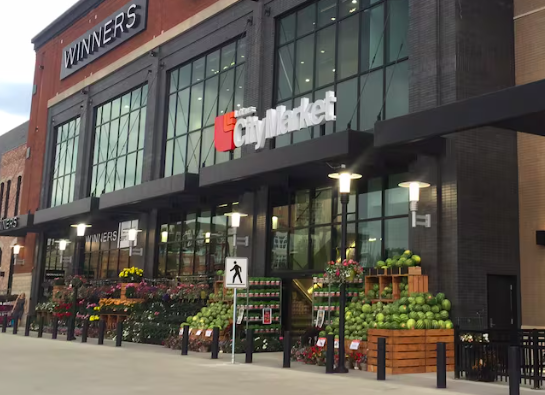
For grocery stores, standardization is a huge competitive advantage. Same basic store size and layout means predictability when it comes to stocking shelves, increasing efficiency of labour. Loblaws’ City Market tends to use smaller, non-standardized floorplates for its stores, but passes the cost of non-standardization onto the consumer, meaning the few smaller (20-30k sqft) stores that exist in urban areas are a luxury.
Existing chain grocers also rely on a standardized fleet for delivery, but large semi-trucks don’t work well in dense urban areas. A neighbourhood-scale grocer would require a different fleet of sprinter vans, necessitating more frequent deliveries.
Between the extreme overhead tied up in storage, logistics and large floorplates, the margins of grocery stores are very thin. Just to exist at all, grocery stores tend to demand over 50% rent discounts compared to the market.
For an individual landlord, this is a non-starter: renting space to a grocer means income after taxes and debt servicing will result in a net loss, or at the very least, the opportunity cost of not renting to a retailer (or several) that will pay full market rent. A developer of a new mixed-use building will not tie up one CRU (commercial retail unit) into one use when it could be split into 5 CRU’s and better diversified.
Grocery stores are natural anchor tenants. For landlords, the added value of a grocery store is the increased rents of nearby CRU’s from increased foot traffic brought about by the grocery store. The REIT’s pro forma ends up penciling out only because the strip-mall as a whole is one entire entity.
Other nearby commercial uses are almost always necessary to spur a grocery store; it cannot exist on its own. The upfront cost of construction for such a site makes land acquisition prohibitively expensive. In walkable communities where land is already valued higher-than-average, large scale land assembly can kill these projects before they get going.
The overhead and slim margins of owning and operating a grocery store make these long-term investments, making grocery stores extremely risk averse. The return is small and must be as close to risk-free as possible. Protecting this small return becomes essential in the pro forma of a grocer. If by year 5, another grocery store opens down the road with predatory pricing, the long-term investment is ruined.
This is where restrictive covenants (RCs) come in. They play a crucial role in the financial management of grocery stores as long-term investments. RCs are a set of property controls put in place by an owner of a piece of land, limiting how it can be used. It runs with the land, meaning future owners are bound to the RC unless it is removed. In Alberta, they cannot affect an area surrounding the property unless each individual owner agrees to register the RC.
Grocery stores use RCs typically to prohibit a former site from being used as a grocery store, often for strategic reasons (inducing traffic to a nearby location). They can also register them on strategic land grabs to prevent a potential grocery store from opening there.
Recently, Edmonton City Council has begun lobbying the provincial government to prevent restrictive covenants from being used by grocery stores, claiming them to be anti-competitive and create “food deserts,” identifying some of Edmonton’s pre-war neighbourhoods as being especially barren of grocery stores.
However, the legal protection of grocery stores is a minor culprit in creating the “food deserts.” The biggest blame is to be put on the structural, logistical and financial barriers that make starting and operating a grocery store that is compatible within a walkable urban environment especially difficult in Edmonton.
Arguably, the most damaging legal protection isn’t the restrictive covenants, rather the non-compete clauses that grocery stores negotiate into their contracts with landlords. Non-compete clauses mean a landlord cannot rent to a different grocery store in the same site or on all sites with the same owner within a radius (note: these are separate from restrictive covenants). Because there are only a handful of retail REITs, a non-compete clause in the contract is even more powerful at controlling where the grocery stores are able to go.
REITs loss-lead their rent to grocery stores to generate traffic for other retail. In contrast to a traditional mainstreet, where there is no individual owner that can tolerate a subsidy for a grocery store. As shown earlier, REITs require complementing retail to subsidize the rent of a grocer. So in a mainstreet area with existing retail, a REIT may deem it unprofitable because there is already too much retail nearby that competes.
It is extremely clear, based on land value alone, that people want to walk to amenities, especially the grocery store. But the existing hurdles in place make it only feasible when luxury apartments exist nearby with residents that can pay for increased cost. Therefore lower income residents, who would be most positively impacted from not needing to own a car, end up poorly served.
Dictionary:
CRU: commercial retail unit.
REIT: real estate investment trust. Ex: First Capital
Pro forma: a financial model of an income producing asset.