Where Did the Third Place Go?

An Op-Ed Written By: Ranon Soans

Stopgap Coffee is tucked into a converted heritage home in Wîhkwêntôwin, the kind of place you only find if someone tells you about it or you happen to walk past. On any given morning it feels like the neighbourhood's living room. You recognize faces. You strike up a conversation in line, or with the person pulling the espresso shot. You leave having talked to someone you weren't expecting to.

Most cities used to have "third places" like this on every other block. The corner pub, the neighbourhood bookstore, the café where people stay longer than they planned. Places woven into the daily texture of a neighbourhood, the kind you wander into rather than plan a trip for.

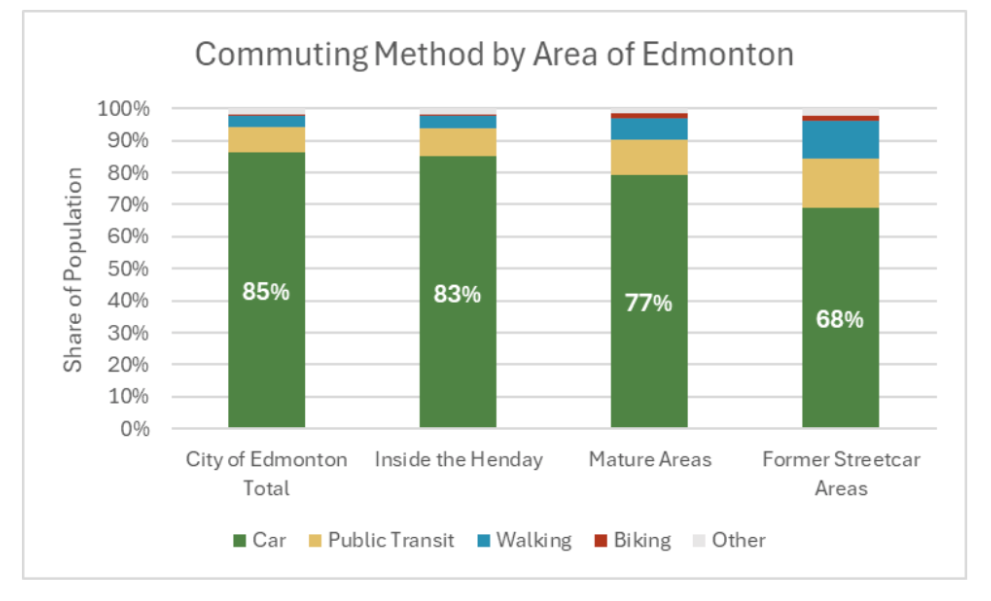
Edmonton had more of them once. Main streets lined with independent shops, accessible on foot and by streetcar, where running an errand and running into a neighbour were often the same trip. Through the latter half of the twentieth century that changed. Cities across North America were rebuilt around the car — the promise being convenience, the ability to get anywhere quickly and easily. And in many ways it delivered. But neighbourhood storefronts emptied out in the process. The corner café, the local grocer, the pub within walking distance — these became harder to sustain when the people who might have walked to them were instead driving somewhere farther away. The rhythms of daily neighbourhood life grew harder to come by. Not because people stopped wanting them, but because the city had been organized around a different set of priorities.

What is striking now is where they are coming back.

Pictured: Iconoclast Coffee, located at 12021 102 Ave NW, within the Oliver Exchange Building.

In Edmonton's densest neighbourhood, Iconoclast Coffee anchors Oliver Exchange, another converted heritage building only a few blocks from Stopgap. On 124 Street, Delavoye has built a bean-to-bar chocolate factory and street-facing café that has become a fixture of the corridor — the kind of place people find on a walk and return to deliberately.

In Strathcona, an older building on 99 Street has been reimagined as Mill Creek West — Frank's Pub and Porchlight Books at street level, with Made by Marcus in a neighbouring converted house next door.

In McQueen, Freson Brothers opened their most central Edmonton location in a reinvested commercial strip at the edge of some of the city's most active infill neighbourhoods. In Bonnie Doon, Duggan's Boundary Irish Pub has been a neighbourhood fixture for years. It seems busier now than it has ever been, as the surrounding blocks have filled in and a new generation of residents has arrived within walking distance. 

None of these places exist in isolation. Each has grown from the neighbourhood around it — people who walk past, stop in, come back, and tell someone else. The money spent at Delavoye or Porchlight Books tends to stay closer to home — in the hands of people who live here, hire here, and are invested in what happens here. The person behind the counter knows the neighbourhood because they are probably a part of it.

There is something that happens to a city when enough of this accumulates. It is difficult to describe precisely but easy to recognize — a sense that the street belongs to the people on it, that you care about your city's future, and that something worth sticking around for, is happening. The neighbourhoods in Edmonton where that feeling is strongest are not accidents. They are the product of sustained investment in the kinds of places and the kinds of density that make daily life enjoyable.

This is why infill is not only a housing argument. The businesses follow the people, the people follow the places, and somewhere in that cycle a neighbourhood stops being somewhere you live and becomes somewhere you belong.

Restrictive Covenants Did Not Kill Neighbourhood Grocery Stores

An Op-Ed Written By: Riker Farmer

For many Edmontonians, a trip to the grocery store is a weekly hassle. Planning large lists, organizing the pantry and hauling several bags into and out of the car, all to avoid returning to the store for an extra few items unforeseen a few days later. If for any reason you do need to return for a few forgotten or unplanned items, the detour is highly inconvenient and inefficient.

Some Edmontonians have access to a convenience store to grab these items, but these stores rarely have the infrastructure required to stock up on perishables like meat and produce. It is impossible to rely on a convenience store to carry what you need to sustain yourself and your family. 

A large supermarket (>30,000 sqft) and a small convenience store (<3000 sqft) sit at distant ends of the spectrum. There are no options existing in the middle that have the “one-stop-shop” selection of the supermarket, but fits the neighbourhood context like a convenience store. This “middle-tier” size of a supermarket would need to be 6000-15000 sqft and despite offering less variety per product type, it would still stock every product necessary to feed a household.

However, this is not an example of our behaviour shaping the built form, rather the built form shaping our behaviour. This missing “middle-tier” of grocery stores are ones where a convenient 10-minute trip after work is not only feasible, but comfortable too. By existing at a neighbourhood scale, these grocery stores would induce trips made car-free or car-light, making this lifestyle not only more practical, but preferable in medium density neighbourhoods.

Right now, car-free lifestyles are only practical in Edmonton’s most urban neighbourhoods like Downtown, Wîhkwêntôwin, Garneau and Strathcona. Here residents can typically walk to the grocery store, but many stores follow the same design language as those in the suburbs; but a single 30-40k sqft grocery store serves a larger radius than one one-third of that size. Those on the periphery of the grocery store catchment area are ill-served by convenient walkability.  These neighbourhoods would instead be better served by smaller stores existing more frequently.

Communities where amenities are within walking distance routinely out-value those without; people crave walkability, yet the grocery stores, the most critical retail amenities, are so rarely adapted to a walkable environment. 

The “missing middle” refers to a systemic housing problem: communities are unable to intensify to match demand due to post-war urban planning, therefore the only housing options available are a single family home, or an apartment accessed by an elevator. If the middle-tier scale of homes built is missing, then it stands to reason that the middle-tier grocery stores would never be built.

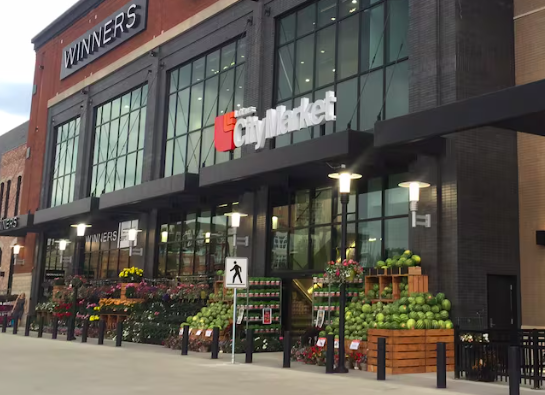
For grocery stores, standardization is a huge competitive advantage. Same basic store size and layout means predictability when it comes to stocking shelves, increasing efficiency of labour. Loblaws’ City Market tends to use smaller, non-standardized floorplates for its stores, but passes the cost of non-standardization onto the consumer, meaning the few smaller (20-30k sqft) stores that exist in urban areas are a luxury.

Existing chain grocers also rely on a standardized fleet for delivery, but large semi-trucks don’t work well in dense urban areas. A neighbourhood-scale grocer would require a different fleet of sprinter vans, necessitating more frequent deliveries.

Between the extreme overhead tied up in storage, logistics and large floorplates, the margins of grocery stores are very thin. Just to exist at all, grocery stores tend to demand over 50% rent discounts compared to the market. 

For an individual landlord, this is a non-starter: renting space to a grocer means income after taxes and debt servicing will result in a net loss, or at the very least, the opportunity cost of not renting to a retailer (or several) that will pay full market rent. A developer of a new mixed-use building will not tie up one CRU (commercial retail unit) into one use when it could be split into 5 CRU’s and better diversified.

Grocery stores are natural anchor tenants. For landlords, the added value of a grocery store is the increased rents of nearby CRU’s from increased foot traffic brought about by the grocery store. The REIT’s pro forma ends up penciling out only because the strip-mall as a whole is one entire entity.

Other nearby commercial uses are almost always necessary to spur a grocery store; it cannot exist on its own. The upfront cost of construction for such a site makes land acquisition prohibitively expensive. In walkable communities where land is already valued higher-than-average, large scale land assembly can kill these projects before they get going.

The overhead and slim margins of owning and operating a grocery store make these long-term investments, making grocery stores extremely risk averse. The return is small and must be as close to risk-free as possible. Protecting this small return becomes essential in the pro forma of a grocer. If by year 5, another grocery store opens down the road with predatory pricing, the long-term investment is ruined.

This is where restrictive covenants (RCs) come in. They play a crucial role in the financial management of grocery stores as long-term investments. RCs are a set of property controls put in place by an owner of a piece of land, limiting how it can be used. It runs with the land, meaning future owners are bound to the RC unless it is removed. In Alberta, they cannot affect an area surrounding the property unless each individual owner agrees to register the RC.

Grocery stores use RCs typically to prohibit a former site from being used as a grocery store, often for strategic reasons (inducing traffic to a nearby location). They can also register them on strategic land grabs to prevent a potential grocery store from opening there. 

Recently, Edmonton City Council has begun lobbying the provincial government to prevent restrictive covenants from being used by grocery stores, claiming them to be anti-competitive and create “food deserts,” identifying some of Edmonton’s pre-war neighbourhoods as being especially barren of grocery stores.

However, the legal protection of grocery stores is a minor culprit in creating the “food deserts.” The biggest blame is to be put on the structural, logistical and financial barriers that make starting and operating a grocery store that is compatible within a walkable urban environment especially difficult in Edmonton. 

Arguably, the most damaging legal protection isn’t the restrictive covenants, rather the non-compete clauses that grocery stores negotiate into their contracts with landlords. Non-compete clauses mean a landlord cannot rent to a different grocery store in the same site or on all sites with the same owner within a radius (note: these are separate from restrictive covenants). Because there are only a handful of retail REITs, a non-compete clause in the contract is even more powerful at controlling where the grocery stores are able to go.

REITs loss-lead their rent to grocery stores to generate traffic for other retail. In contrast to a traditional mainstreet, where there is no individual owner that can tolerate a subsidy for a grocery store. As shown earlier, REITs require complementing retail to subsidize the rent of a grocer. So in a mainstreet area with existing retail, a REIT may deem it unprofitable because there is already too much retail nearby that competes.

It is extremely clear, based on land value alone, that people want to walk to amenities, especially the grocery store. But the existing hurdles in place make it only feasible when luxury apartments exist nearby with residents that can pay for increased cost. Therefore lower income residents, who would be most positively impacted from not needing to own a car, end up poorly served.


Dictionary:

CRU: commercial retail unit.

REIT: real estate investment trust. Ex: First Capital

Pro forma: a financial model of an income producing asset.

Downtown is Turning a Page and Not Enough People are Talking About It

An op-ed about Edmonton’s newest O-Day’ min Park

Written by: Riker Farmer

“Downtown revitalization” has been a talking point echoed by media, politicians and business people in Edmonton for a long, long time.

Revitalization efforts that get the most political and media attention are the ones that may give suburban dwellers more reason to journey downtown.

Because of this, the most impactful revitalization project that has been made to this day has gotten little attention outside of the development community.

O-Day’min Park is not about generating new trips to downtown. Rather, it’s a new central park in a part of downtown that has been neglected for decades, and is capitalizing on what downtown does best: public spaces and third places.

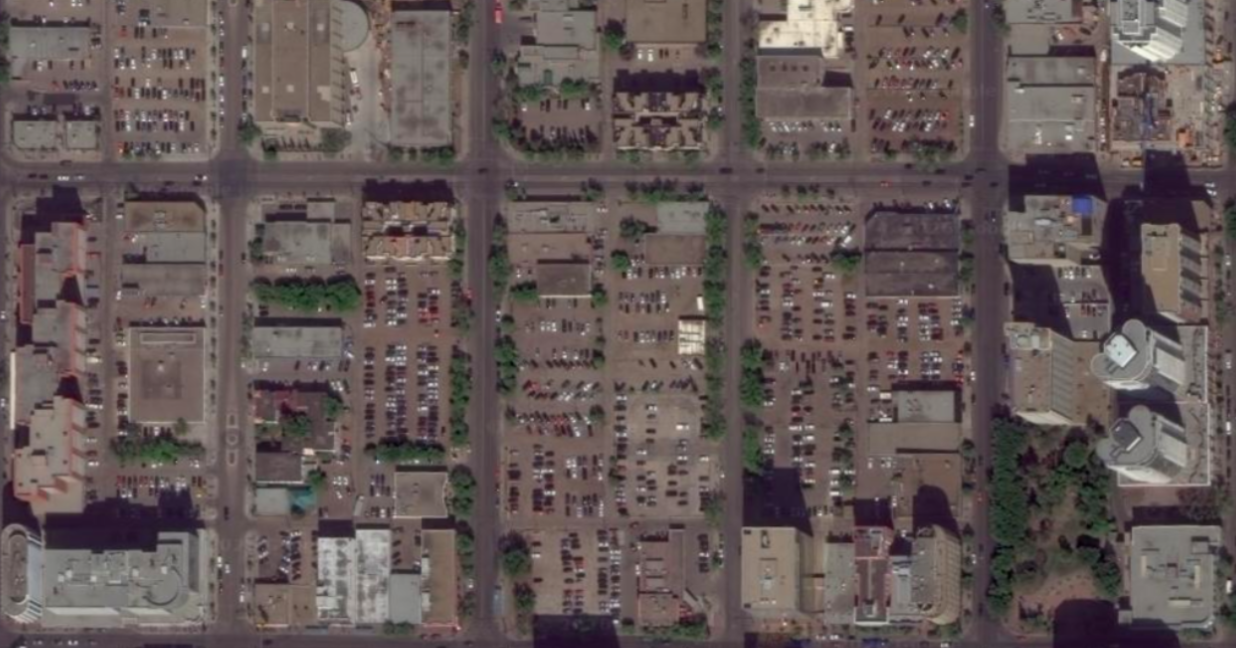
Seen above: 102 Avenue from 109 Street (left) to 104 Street (right)

Long before O-day’min Park opened, this section of downtown housed warehouses and other light industrial uses for the CN rail yard that used to exist north of 104 Avenue. Some of these warehouses have been well preserved with their original brick facades, forming much of the 104 Street streetscape.

When the downtown railyard began to end its operations in the 1980s, the warehouses were bought by speculators and developers and converted into parking lots for interim use. By the late 1980s, a severe recession reversed almost all plans for development. Almost 40 years later, these lots remained undeveloped.

Development needed a gentle nudge and O-Day’min Park was designed to do just that.

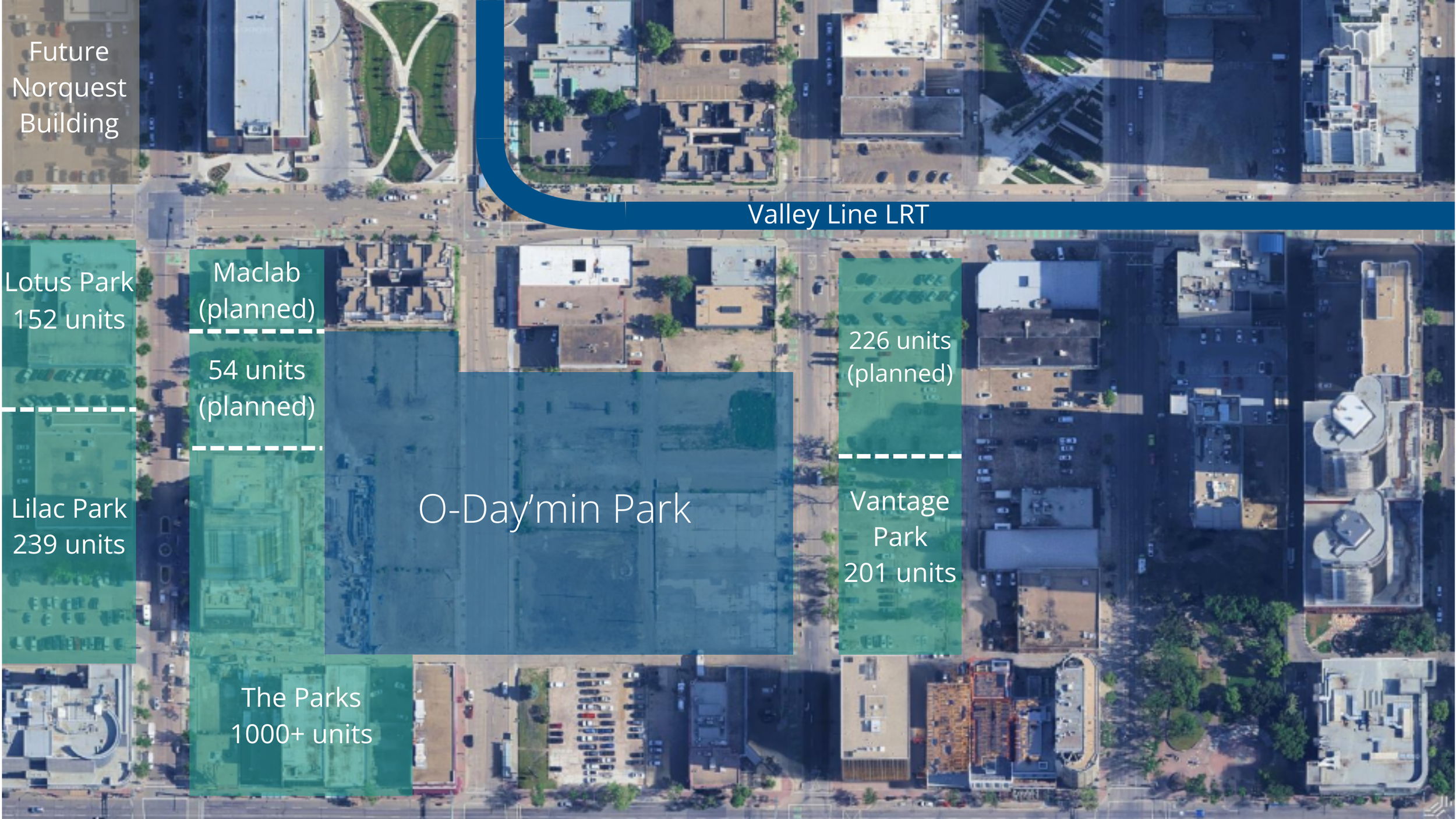
The Parks, by Pangman Developments and Maclab Development Group, was the first on board to develop this area of downtown. This project is proposed to deliver over 1000 units across three phases, with the first being completed in early 2025.

As well, Westrich Pacific will deliver 607 units across three projects: Lilac Park (239 units), Lotus Park (152 units) and Vantage Park (201 units). As of February 2026, all three are under construction.

Another project on 108 Street will deliver 54 units and another on 106 Street is proposed to deliver 226.

Maclab has plans for a project on 102 Avenue which may become known later this year.

If you’re keeping track, that is almost 1900 units planned, proposed or underway. All with front doors less than 100 meters from O-Day'min Park.

An explosion of development surrounding the park totals 2.25 hectares, with over 4 hectares including the park. 

But it is less about the size of this development. What will be impactful for the vibrancy of downtown streetlife and the vitality of downtown business is the 2000 new units bringing between 2500-3500 new permanent residents. In comparison, the first phase of Ice District saw roughly 500 units across 7.66 hectares of development, roughly one quarter of the density of the O-Day’min area.

Density is incredibly powerful for a few reasons. Aside from the increased patronage of businesses in the area, density enforces public safety through a concept known as “eyes on the street.” With more permanent residents frequenting public spaces, the constant attention on these areas drastically reduces the likelihood of petty theft and vandalism. 

Without density it is clear why areas of downtown continue to struggle. Much of downtown has been designed with “downtown as a destination” for suburban dwellers, only to be vacated during off-hours. Much of downtown's streets tend to go unmonitored for large times of the day, contributing to a reduced feeling of safety, which perpetuates dwindling foot traffic.

Situated between three rapid transit lines, the location provides car-free access to almost every corner of the city. Furthermore, the location serves two post-secondary institutions, drawing daily foot traffic from students, faculty and staff. With the plethora of urban amenities now available, it is no wonder why such an explosion of development is occurring.

This project can serve as a framework for future development efforts. Inducing development should be first and foremost about helping an area realize its full potential. 

O-Day’min Park met the need for a community space and developers have bought into the vision.